


Colostrum management is the first and most decisive step in securing a calf’s survival, health, and long-term performance. As calves are born without immune protection, the quality, quantity, timing, hygiene, and verification of colostrum intake determine the success of passive immunity transfer. Applying science-based colostrum management practices reduces early-life mortality, strengthens disease resistance, and lays the foundation for lifelong productivity in dairy herds.

Export Technical Manager
Elvor – Savencia Group

Export Sales Manager
Elvor – Savencia Group
Calf rearing represents a major investment for the future of a dairy farm, and its success is determined by many factors, including the management of the first hours of life. Colostrum provides energy, essential antibodies, and nutrients for the future performance and health of the animal. Effective management is critical to ensure passive immunity transfer, reducing mortality while boosting future production.
THE FUNDAMENTALS OF COLOSTRUM MANAGEMENT: THE 5Q’s RULE
Optimal colostrum management follows a precise methodology summarized by the “5Q’s” rule. Each of these parameters has to be strictly monitored to ensure the survival and development of the newborn calf. Each “Q” is defined by specific scientific thresholds that must be met.
Quality is defined by the concentration of immunoglobulin G (IgG) in the colostrum. Colostrum is considered high quality when it contains at least 50 g/L of IgG1. In practice, this corresponds to a value greater than 22% on the Brix scale when using a refractometer. Scientific data indicates that colostrum measuring less than 18% Brix is highly insufficient, while values above 28% Brix represent excellent quality. It is important to note that visual appearance, such as color or density, is not a reliable indicator of actual antibody concentration. However, more yellow or darker colostrum generally contains higher fat content.
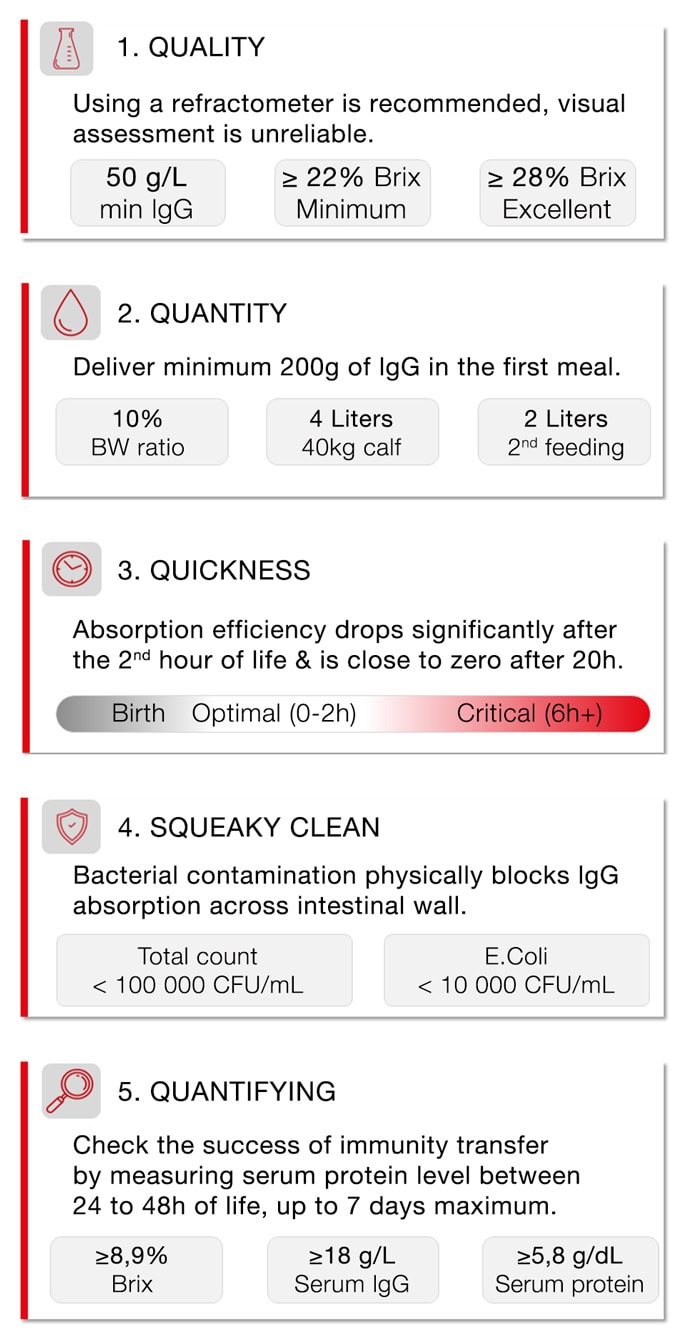
The Quantity distributed must provide the calf with a sufficient immune load to establish protection. A newborn calf requires an intake of minimum 200 g of IgG in its first meal. This is typically achieved by feeding a volume equivalent to 10% of the calf’s body weight (BW), which makes approximately 4 liters for a 40 kg Holstein calf. Feeding only 2 liters has been shown to result in significantly lower serum IgG status and increased incidence of scours. While a second feed of 2 liters is recommended within 12 hours, providing more than 12% BW in a single feed may cause gastric disorders without necessarily increasing serum IgG levels2.
Quickness is one of the most critical factors because the calf’s intestinal permeability to large molecules like antibodies decreases exponentially after birth. IgG absorption is highest within the first two hours of life (approaching 30%) and drops to nearly zero after 20 hours. Simultaneously, the quality of colostrum in the udder degrades quickly: there is a 25% loss of IgG concentration by the second milking (12 hours) and a 50% loss after 24 hours3.
sQueaky clean management focuses on hygiene to prevent the calf from ingesting pathogens before its immune system is established. Scientific standards require colostrum to have a total bacterial count below 100,000 CFU/mL and less than 10,000 CFU/mL for E. coli. High bacterial loads directly interfere with the efficiency of antibody absorption across the intestinal wall.
Finally, Quantifying involves verifying the success of passive immunity transfer by measuring serum protein levels in the calf ideally, between 24 to 48 hours of age, or up to 7 days maximum. A good transfer is marked by serum IgG levels ≥ 18.0 g/L or a Serum Total Protein (STP) ≥ 5.8 g/dL (Brix ≥ 8.9%)4.
BIOLOGICAL IMPORTANCE OF IMMUNITY TRANSFER
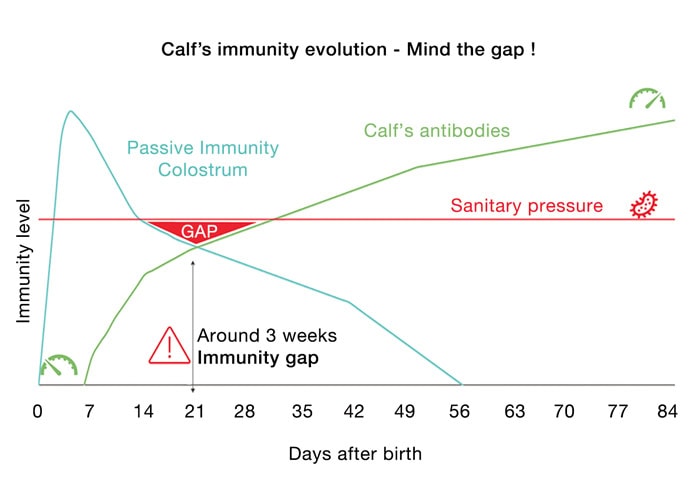
Unlike many species, cattle’s placenta is impermeable to large proteins, including immunoglobulins. Consequently, calves are born without immune defences and no circulating antibodies to protect them from environmental pathogens. They depend entirely on the passive immunity transferred via colostrum to survive environmental challenges in the first weeks of life until their own immune system becomes entirely functional at approximately 3 to 4 weeks of age.
When the consumption of colostrum is not of the right quality or quantity, it may lead to Failure of Passive Transfer (FPT), defined as serum IgG levels below 10 g/L. It can have significant economic and health consequences, especially on the long term. Research indicates that calves with poor immunity transfer are 4.3 times more likely to die before weaning and are significantly more susceptible to disease: the risk of diarrhea increases by 49%, and the risk of respiratory diseases increases by 39%4,5.
Beyond immune protection, colostrum acts as a complex energetic soup containing essential elements in higher quantity compared to milk, like growth factors, hormones, bioactive molecules, or vitamins. It contains IGF-1 (which is 300 times more concentrated in colostrum than in mature milk), insulin, and prolactin, all of which stimulate the early development of intestinal microvilli. These benefits persist throughout the animal’s life: heifers receiving 4 liters of quality colostrum at birth produce an average of 1 kg more milk per day during their first lactation than those receiving only 2 liters, representing a total gain of over 550 kg across two lactations6.
Best practices for maximizing colostrum quality start with the cow’s dry period. A balanced diet rich in proteins, energy, minerals, and vitamins is essential, at least 3 to 4 weeks before calving. Furthermore, vaccinating the dry cows against pathogens such as Rotavirus, Coronavirus, and E. coli specifically enriches the colostrum with targeted antibodies, providing the calf with superior local and systemic protection.
DISTRIBUTION BEST PRACTICES
The distribution method directly influences the quantity and speed of colostrum ingestion. Allowing the calf to suckle the mother is not recommended because it provides no control over the quality or volume consumed. In France, data shows that around half of farmers still allow suckling, which frequently results in failure of passive transfer. Using a bottle or a nipple bucket is preferred, as the nipple stimulates the oesophageal groove reflex, directing the colostrum to the abomasum. If a calf refuses to drink, oesophageal drenching is a scientifically validated technique that guarantees the administration of the full 4 Liters requirement in a single meal.
Hygiene is often the weakest link in colostrum management. It is estimated that 75% of colostrum samples exceed bacterial contamination limits, often due to biofilms in scratched buckets or poorly cleaned hoses. It is particularly essential to have a rigorous hygiene as some bacteria can double their population every 20 minutes. To ensure cleanliness, all equipment must be rinsed with ambient temperature water, washed with detergent at a temperature above 50°C, disinfected, and air-dried. On top of a visual checking to control hygiene, the use of an ATP-meter allows for instant verification of surface cleanliness. It is also possible to collect samples for culturing.
Regarding conservation, fresh colostrum should not remain at room temperature for more than 30 minutes. It can be refrigerated for 48 hours, or up to 7 days if a preservative is added. For long-term storage, colostrum can be frozen at -20°C for up to one year to maintain a safety stock for emergencies. Thawing must be conducted slowly in a water bath at a temperature below 50°C. The use of microwaves or boiling water is prohibited as it may alter the delicate molecules like antibodies. Pasteurization (60°C for 60 minutes) is a recommended practice that reduces microbial load, thereby improving the rate of transfer into the calf’s bloodstream.
A NEW TECHNICAL COLOSTRUM REPLACER
In situations where maternal colostrum is unavailable, of insufficient quality (<22% Brix), or comes from cows infected with diseases, a high-performance substitute is required. Elvor Immune is a technologically advanced scientific solution specifically formulated to secure calf’s start in life through a formula that integrates both immunity and nutrition to meet all the needs of the newborn calf.
A primary advantage of Elvor Immune is its high concentration of colostrum powder (50%), providing a direct and reliable source of bovine IgG for systemic immunity. This base is supplemented with 10% egg products containing immunoglobulins Y (IgY). These IgY molecules offer a complementary and synergistic effect: while bovine IgG circulate in the blood to protect the entire body, IgY act locally within the intestinal lumen. They specifically bind to pathogens like Rotavirus, E. coli and cryptosporidium, preventing them from adhering to the intestinal wall. This dual-barrier approach maximizes survival chances and significantly reduces the incidence of early digestive disorders.
Beyond immune support, Elvor Immune contains high-tech nutritional additives to support the newborn’s metabolism. It includes partially chelated trace elements (Iron, Zinc, Manganese) and organic selenium, which offer superior bioavailability compared to inorganic forms, ensuring optimal assimilation for skeletal and immune development. The addition of live yeasts and fructo-oligosaccharides (FOS) promotes the establishment of beneficial gut microflora and accelerates rumen development. By providing the right IgG levels, Elvor Immune allows farmers to overcome colostrum deficiencies while providing the necessary energy for thermoregulation and vigorous early growth.
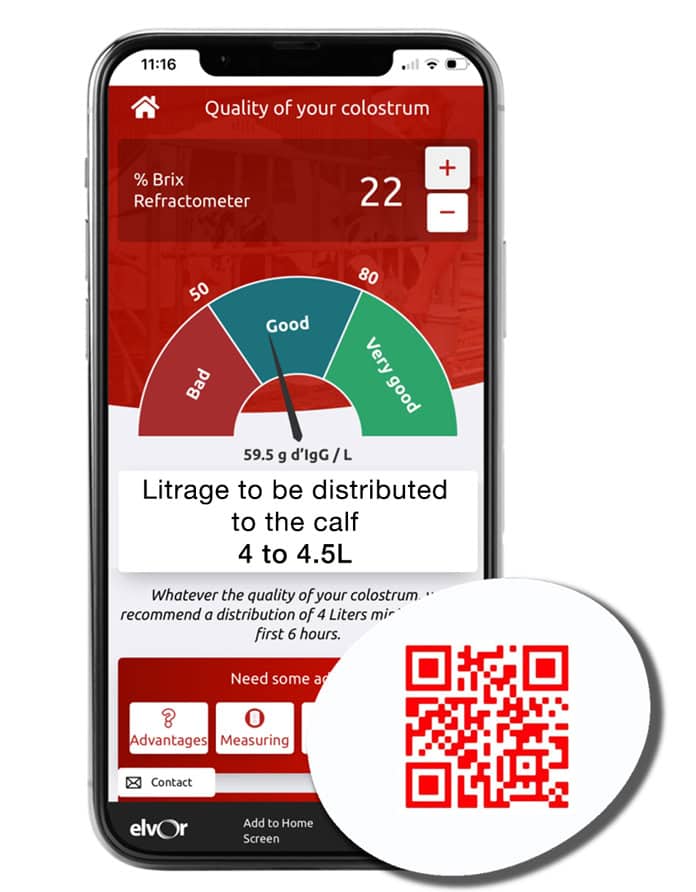
Elvor Immune can be administered as a complete or partial replacement of the colostrum: its dosage must be calculated according to quality and quantity of the colostrum. It should be fed within the first two hours of life to maximize immunoglobulin absorption. Farmers can reconstitute the appropriate dosage in warm water or in the mother’s colostrum: it guarantees the newborn receives essential systemic protection and local intestinal defence, regardless of maternal colostrum quality. Elvor App can help to check colostrum quality and to give the recommended Elvor Immune dosage.
In summary, colostrum management is the foundation of a dairy herd’s future productivity. Strict adherence to the 5Qs, supported by precision tools and innovative solutions like Elvor Immune, transforms a major health risk into a powerful lever for sustainable herd performance. A calf requires the biological foundation of colostrum to reach its full genetic potential.
References
1Sockett et al., 2023. Investigation of Brix refractometry for estimating bovine colostrum immunoglobulin G concentration. Front. Vet. Sci. 10:1240227.
2Frederick et al., 2025. Effects of feeding colostrum volume at 6%, 8%, 10%, or 12% of birth body weight on efficiency of immunoglobulin G absorption, gastric emptying, and post feeding behavior in Holstein calves. J Dairy Sci. 108 (12), pp 13680-13690.
3Oyeniyi and Hunter, 1978. Colostral constituents including immunoglobulins in the first three milkings postpartum. J Dairy Sci. 61(1), pp 44-8.
4Lombard et al., 2020. Consensus recommendations on calf- and herd-level passive immunity in dairy calves in the United States. J Dairy Sci. 103(8), pp 7611-7624.
5Crannell and Abuelo, 2023. Comparison of calf morbidity, mortality, and future performance across categories of passive immunity: A retrospective cohort study in a dairy herd. J Dairy Sci. 106(4), pp 2729-2738.
6Faber et al., 2005. Case study: Effects of colostrum ingestion on lactational performance. The Professional Animal Scientist, 21(5), pp 420-425.
About Mélody Baudon
With a master’s degree in Animal Production, Mélody Baudon joined Elvor in 2025 and began providing technical and marketing support. Baudon aims to showcase the company’s expertise in milk replacers and calf management worldwide. She previously served as an International Technical and Marketing Manager specialised in mineral nutrition for ruminants.About Julia Novitska
With a master’s degree in International Business, Julia Novitska has served as Export Sales Manager at Elvor since 2022. With over eight years of specialised experience in the milk replacer industry, she currently oversees business follow-up and development across Northern and Eastern Europe, the Balkans, Middle East, and Asia. Beyond commercial promotion, Julia provides her support to guide and optimise the use of milk replacers products.