


Kalo leaves present a promising alternative feed ingredient for poultry, offering high protein content, essential vitamins, and improved digestibility. Studies indicate that incorporating kalo leaf meal at levels of 5% to 7% in broiler diets enhances growth performance, nutrient composition, and cost efficiency.

University of Hawai’i at Mānoa, College of Tropical Agriculture and Human Resources

University of Hawai’i at Mānoa, College of Tropical Agriculture and Human Resources
Taro (Colocasia esculenta), widely known as kalo in Hawai’i, is a tropical plant that offers a viable alternative feed source for poultry. Studies suggest incorporating kalo leaves into chicken diets can enhance nutrient composition, digestibility, and meat quality while reducing feed costs. A study conducted in Ethiopia (Temesgen, Retta & Tesfaye, 2017) found that kalo leaves, rich in proteins, carotene, and trace minerals, can replace up to 7% of soybean meal in chicken feed, improving growth performance and cost efficiency. This alternative feed source is particularly relevant in Hawai’i, where livestock producers face high feed costs and food security concerns.
NUTRITIONAL COMPOSITION OF KALO LEAVES
Kalo leaves provide essential nutrients beneficial to poultry, including:
• Proteins: Crucial for the growth and development of chickens.
• Carotene: A precursor to vitamin A, essential for vision, growth, and immune function.
• Trace Minerals: Includes iron (Fe), zinc (Zn), and copper (Cu), vital for metabolic processes.
• Vitamins: Contains vitamin C, which supports immune function and overall health.
• Digestible Fiber: High in soluble fiber, promoting nutrient absorption and digestion.
• Ash Content: Indicates a good supply of minerals essential for poultry nutrition.
Kalo leaves contain 86.94% water, 16.48% protein, 17.24% fiber, 1.45% potassium, 0.4% phosphorus, 4.3% fat, 30.46% digestible carbohydrates, and provide 3966 kcal/kg of energy (Suwitari N., Suariani L., Yudiastari N. 2022).
DIET PREPARATION AND TREATMENT FORMULATION
Freshly picked kalo leaves were separated from their veins and dried in a shaded environment for four days. The dried leaves were then ground into a fine powder using a stainless steel hammer mill (1.6 mm particle size) and stored in a cool, dry place for later use in feed formulations.
Four dietary treatments were prepared, incorporating kalo leaf meal at 0%, 3%, 5%, and 7% levels to replace soybean meal as a protein source in broiler diets. The feed formulation included maize (Zea mays), noug seed (Guizotia abyssinica) cake, wheat middlings (Triticum sp.), soybean cake (Glycine max), vitamin premix, salt, limestone, methionine, and lysine to meet the chickens’ nutrient requirements (Temesgen et al., 2017).
RESULTS
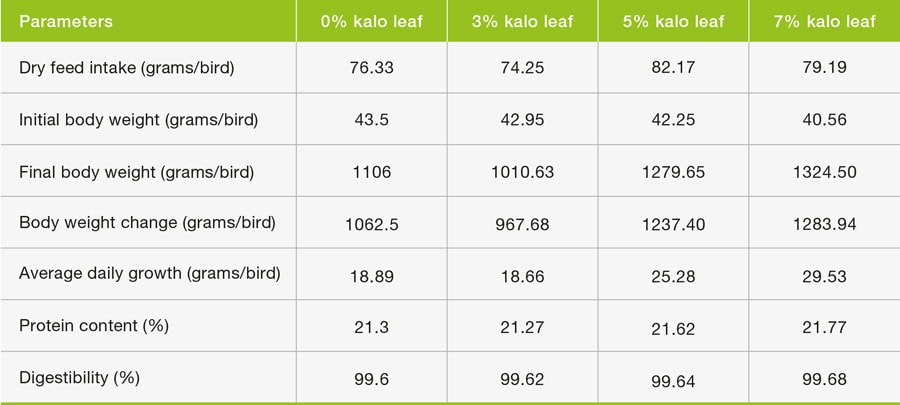
Statistical analysis demonstrated that incorporating kalo leaf meal significantly (P < 0.01) affected the digestibility of crude protein. The results showed improved growth performance, particularly at higher inclusion rates (5% and 7%).
Temesgen et al. (2017) also found that chickens fed higher levels of kalo leaf meal (5% and 7%) had breast muscles with superior nutrient composition, higher protein, lower crude fiber, and enhanced vitamin C content compared to those fed lower levels.
 ANTI-NUTRITIONAL FACTORS
Despite its benefits, kalo leaves contain some anti-nutritional compounds, including:
• Oxalate: Binds to minerals, reducing bioavailability.
• Tannin: Interferes with protein digestion and nutrient absorption.
• Phytate: Binds essential minerals, decreasing absorption efficiency.
However, the levels of these compounds in kalo leaves are relatively low and do not significantly impact feed intake or nutrient utilization in chickens. Anti-nutritional factors can be mitigated by processing methods such as drying, heating, or fermentation before feeding to poultry according to Suwitari et al. (2022).
CONCLUSION
Kalo leaves present a promising alternative feed ingredient for poultry, offering high protein content, essential vitamins, and improved digestibility. Studies indicate that incorporating kalo leaf meal at levels of 5% to 7% in broiler diets enhances growth performance, nutrient composition, and cost efficiency. While kalo leaves contain some anti-nutritional factors, proper processing methods effectively mitigate their impact, ensuring safe and beneficial inclusion in poultry feed. Given Hawai’i’s high feed costs and food security concerns, utilizing kalo leaves as a sustainable feed source could provide economic and nutritional advantages for local poultry producers.
References:
• Temesgen, M., Retta, N., Tesfaye E. (2017). Nutrient Composition and Digestibility of Taro Leaf in the Diets of Chicken and Effects on the Meat Quality. Journal of Nutrition, Health & Food Engineering, 7(3): 00238. DOI: 10.15406/jnhfe.2017.07.00238
• Suwitari, N., Suariani, L., Yudiastari, N. (2022) The Effect of the Use of Taro Leaf Flour on the Digestiveness of Native Chicken Rate. In WICSTH 2021: Proceedings of the 1st Warmadewa International Conference on Science, Technology and Humanity, WICSTH 2021, 7-8 September 2021, Denpasar, Bali, Indonesia (p. 56). European Alliance for Innovation.
Disclaimer
This literature review is for informational and educational purposes only. While kalo leaves show promise as an alternative poultry feed, producers should carefully consider anti-nutritional compounds, proper feed formulation, and poultry health. The University of Hawai’i at Mānoa and the authors are not liable for any outcomes resulting from the use of kalo leaves in poultry feed without professional evaluation and guidance.
About Yunuen Bustamante
Yunuen Bustamante recently joined the University of Hawaii at Manoa as a Livestock Extension Agent for Oahu County. She holds a Master’s degree in Agroforestry from the Autonomous University of Chapingo in Mexico. Her extension program focuses on promoting sustainable livestock practices, improving animal nutrition and health, advancing animal welfare, and providing youth education.About Melelani A. Oshiro
Melelani A. Oshiro has been with UH Mānoa’s College of Tropical Agriculture and Human Resilience (CTAHR) since 2009, transitioning from Research Assistant to Associate Extension Agent for Livestock Programs in 2019. She holds an MS in Animal Science, focused on grass-finished beef systems. Her Extension work centers on livestock production, health, husbandry, and low-stress stockmanship, and she also serves as Hawaii’s Beef Quality Assurance (BQA) Coordinator and trainer.