


Alltech’s latest harvest analysis highlights evolving mycotoxin risk patterns across Europe, the United States and Canada based on the assessment of more than 2,000 new-crop samples. The findings underscore the influence of weather variability, regional crop conditions and multi-mycotoxin exposure on feed safety.
 The 2025 harvest season has delivered new insights and fresh challenges for feed safety across Europe, the United States and Canada. Drawing on analysis of more than 2,000 new-crop samples, Alltech’s latest Harvest Analysis provides a snapshot of global mycotoxin trends and highlights strategies for managing mycotoxin risks to animal health and nutrition.
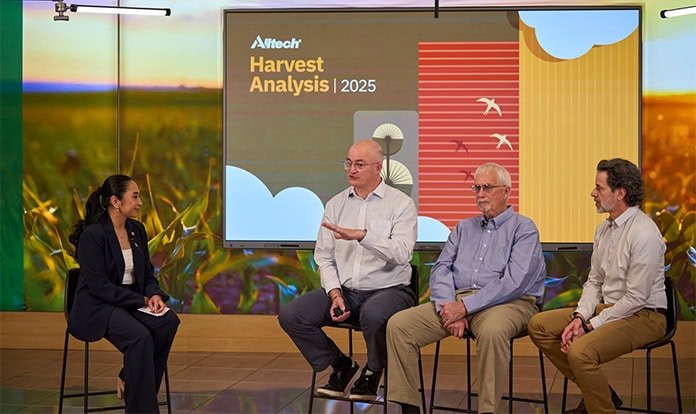
Earlier this year, Alltech presented the findings during the global broadcast “From Field to Feed: 2025 Crop and Mycotoxin Analysis,” streamed from its Kentucky headquarters. The event brought together industry experts to discuss harvest results, weather impacts, market outlooks and strategies for managing mycotoxin risks throughout the feed supply chain. One of the key themes highlighted during the broadcast was the growing role of artificial intelligence (AI) in predicting and managing mycotoxin risk.
WEATHER REMAINS A KEY RISK DRIVER
Weather continues to play a major role in both crop performance and mycotoxin development. During the broadcast, Dr. Jan Dutton, CEO of Prescient Weather Ltd., emphasized that weather variability directly affects yield outcomes and toxin risk, noting that predictive tools such as CropProphet can help producers better manage production and market uncertainty.
According to Dr. Dutton, the 2025 season showed clear regional contrasts. In the United States, crops experienced periods of significant heat in early and late July, while weather conditions were milder during corn silking. Canada’s oat-growing regions faced notable dryness from May through June. In Europe, early-season temperatures were above average, followed by dry conditions in June and partial recovery in July.
Dr. Max Hawkins from Alltech added that regional variability was greater in 2025 than in 2024. In the U.S., crop health and mycotoxin levels were influenced by challenges such as Southern corn rust, tar spot, wind damage and excess rainfall, particularly affecting sensitive species like ruminants.
He also highlighted a geographical shift in risk patterns. Mycotoxin pressure moved westward in the U.S., while eastern regions saw some decline. This year-to-year movement underscores the importance of consistent testing of feedstuffs when formulating safe total mixed rations (TMRs).
STORAGE AND MULTI-MYCOTOXIN EXPOSURE
While crop quality is typically highest at harvest, it can decline rapidly during storage and transport if not properly managed. Effective post-harvest handling therefore remains critical to prevent quality deterioration.
Another persistent challenge is multi-mycotoxin exposure. Even when individual toxin levels appear moderate, the presence of multiple mycotoxins can produce additive or synergistic effects that reduce feed intake, weaken immunity and lower animal performance.
According to the analysis, most samples in 2025 contained more than one mycotoxin. This highlights the need to evaluate total toxin load rather than focusing solely on single-toxin thresholds, particularly for high-producing animals where even small health challenges can translate into economic losses.
REGIONAL CONTAMINATION TRENDS
Regional analysis revealed distinct contamination patterns. In Europe, warmer conditions in Southern Europe contributed to elevated aflatoxin levels in corn. Barley showed higher risk than wheat, averaging 6.7 mycotoxins per sample. Northwestern European forages were mainly challenged by Penicillium mycotoxins, while corn silage more commonly contained Fusarium toxins such as type B trichothecenes.
In the United States, diseases including Southern corn rust and tar spot, along with wind damage, contributed to higher mycotoxin levels across corn products. Corn silage averaged 5.5 mycotoxins per sample, primarily Fusarium-related, while corn grain averaged 6.5 mycotoxins per sample.
In Canada, grain samples showed moderate overall risk. DON appeared in 40% of samples, averaging 1,891 ppb, with a maximum level of 679,211 ppb. Forages carried greater risk, with DON present in 69% of samples, T2-HT2 in 54% and zearalenone in 79%.
AI’S EXPANDING ROLE IN RISK PREDICTION
Artificial intelligence is increasingly being used to support mycotoxin risk management. Dr. Alexandros Yiannikouris of Alltech highlighted collaborative research with Wageningen University and industry partners to develop advanced European grain models.
These AI-driven systems integrate more than 200 risk factors, allowing the prediction of elevated mycotoxin risk even when crops appear visually healthy or when historical averages suggest low concern. The predictive capability also helps guide targeted nutritional solutions, including technologies such as the Mycosorb® Evo range designed to address challenges such as DON and fusaric acid.
PREPARING FOR 2026
The 2025 findings confirm that mycotoxin risk remains highly variable, region-specific and strongly influenced by weather and crop stress, with multi-mycotoxin contamination continuing to be common across grains and forages.
Understanding these risks will be essential as producers plan for the 2026 season. According to Dr. Dutton, U.S. producers should be aware of the likely development of El Niño by summer 2026, which historically brings wetter-than-normal conditions across major growing regions and may increase mycotoxin risk.
Experts emphasize that regular mycotoxin testing, comprehensive risk assessment and appropriate control strategies—both before and after harvest—remain the foundation of effective mycotoxin management in protecting animal health, sustaining performance and safeguarding profitability.